
SBLC Monetization
Unlock liquidity from bank-issued instruments through a structured monetization facility. TRG Venture Capital International Investment G.P. Limited offers a coordinated SBLC issuance and monetization service designed to convert a bank-issued Standby Letter of Credit into usable financing.
What Is SBLC Monetization?
SBLC monetization is the process of converting a bank-issued Standby Letter of Credit into a financing facility. Once the instrument is authenticated and the terms are assessed, a percentage of the face value is made available as proceeds for legitimate commercial use.
The instrument itself remains a contingent bank obligation; the monetization creates a structured funding arrangement supported by that obligation.
The service is intended for established commercial entities, project developers and trade-oriented companies that require working capital or project funding. The key differentiator is TRG closed-loop approach: issuance and monetization are handled under one structure, rather than requiring the client to obtain an instrument from one provider and then locate a separate third party to monetize it.
How SBLC Monetization Works
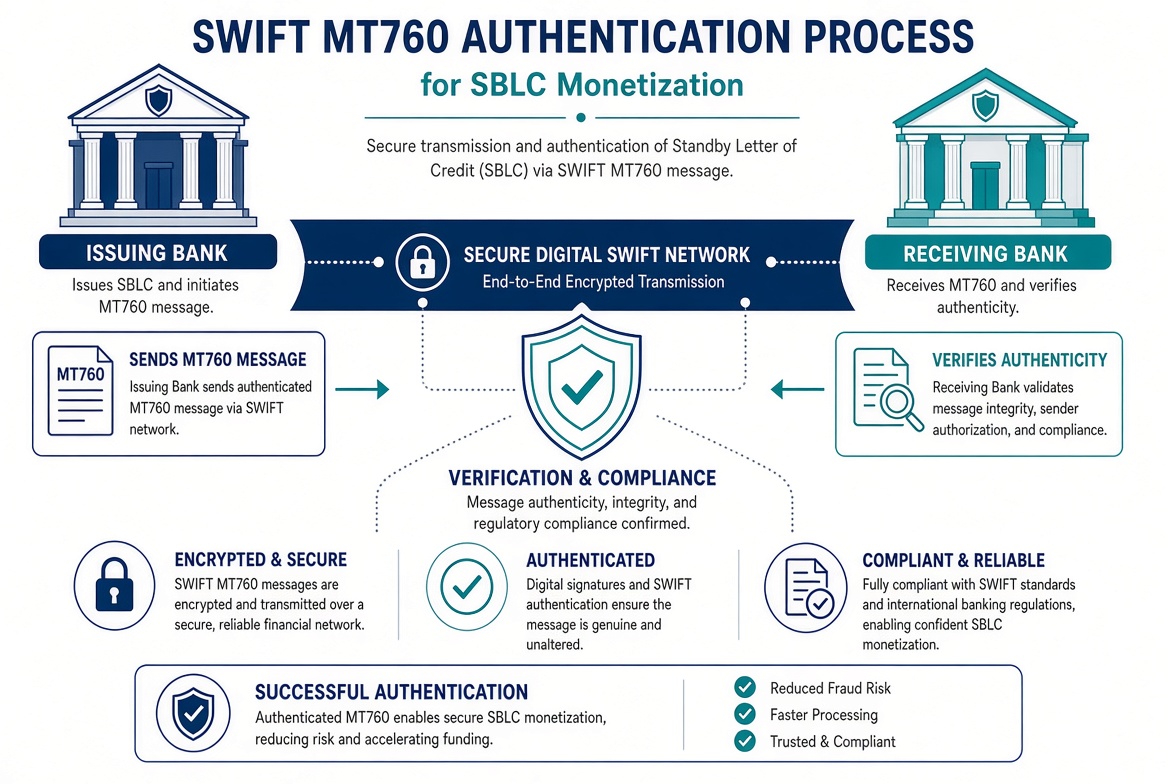
The practical sequence is straightforward: an SBLC is issued by a recognised bank, the instrument is transmitted via SWIFT, authenticity and terms are verified, a monetization assessment is completed, an agreed financing structure is put in place, and proceeds are released according to the facility terms.
This flow gives the client a clear path from instrument to usable capital.
SBLC Monetization Process
Initial consultation and eligibility review
A preliminary review of the corporate profile, the instrument and the intended use of proceeds.
Submission of corporate and instrument documentation
Company, financial and instrument documentation is collected and reviewed.
Full KYC and compliance checks
Directors, shareholders, ultimate beneficial owners and source of funds are verified.
SWIFT-based instrument verification and authentication
The instrument and its transmission are authenticated before any assessment proceeds.
Term sheet and facility documentation
The financing structure, percentage and costs are documented before any commitment is made.
Final approval and release of proceeds
Proceeds are released according to the agreed facility terms.
What Is an SBLC?
A Standby Letter of Credit (SBLC) is an irrevocable undertaking issued by a bank. Core elements include:
- Applicant, the party requesting the instrument
- Issuing bank
- Beneficiary
- Face value
- Tenor
- Transmission via SWIFT MT760
- Irrevocable character
- Cash-backed structure where applicable
It is a contingent payment commitment of the issuing bank, not cash itself.
How SBLCs Are Used
Credit enhancement
Strengthening the credit standing of a commercial arrangement for the beneficiary.
Trade finance support
Supporting procurement and international supply obligations.
Working capital arrangements
Business working-capital structures backed by an issued instrument.
Project financing
Project financing requirements supported by the instrument and structure.
Performance obligations
Performance or other contractual obligations set out in the instrument.
Documented commercial purposes
Other documented commercial purposes acceptable to the institution.
SBLC Monetization for Business and Project Financing
Companies and project sponsors use monetized SBLCs to secure capital for expansion, procurement, infrastructure development, energy projects, commodity transactions and other commercial activities when conventional bank lending is constrained by collateral or timeline requirements.
SBLC Monetization and Non-Recourse Financing
Certain facilities are structured on a non-recourse or limited-recourse basis, meaning the financing is supported primarily by the instrument and the agreed commercial structure rather than additional personal guarantees, subject to the specific terms of each facility.
SBLC Issuance and Monetization Through TRG
TRG provides both issuance of the SBLC and its subsequent monetization within a single coordinated structure. Clients do not need to obtain an instrument from one provider and then search for a separate monetizer.
This closed-loop model is intended to reduce intermediary layers and keep the process under unified oversight.
Who Can Use SBLC Monetization?
Established corporations
Corporations with verifiable operations and a documented commercial purpose.
Project development companies
Infrastructure and development sponsors requiring structured project funding.
Trade and commodity firms
Companies financing procurement or international supply obligations.
Energy and natural-resources sponsors
Sponsors of energy and resources projects with instrument-backed requirements.
Other commercial entities
Entities able to demonstrate a legitimate use of proceeds.
SBLC Monetization Requirements
Corporate and KYC
- Properly incorporated corporate entity
- Complete KYC package for the company, directors and beneficial owners
Instrument criteria
- Acceptable issuing bank, higher-rated institutions preferred
- Instrument meeting minimum face-value and remaining-tenor criteria
Purpose and compliance
- Clear, documented commercial purpose for the proceeds
- Full compliance with anti-money-laundering and sanctions standards
LTV, Fees and Timeline
Financing percentage (loan to value)
The financing percentage is determined after assessment of the issuing bank rating, the instrument terms, the remaining tenor and the overall risk profile. Market discussions commonly reference ranges that vary according to bank quality and structure; final figures are set only after verification.
Fees and costs
Fees and costs are calculated according to transaction size and complexity. All charges are disclosed in the term sheet before any commitment is made.
Timeline
Once complete documentation is received and the instrument has been successfully verified, the process moves through assessment, documentation and funding stages. Actual timing depends on bank response times, compliance clearance and the complexity of the structure.
Documents Required for SBLC Monetization
Documentation checklist
- Corporate information sheet or company profile
- Full KYC package covering directors, shareholders and ultimate beneficial owners
- Recent financial statements
- Copy of the SBLC or formal bank readiness confirmation
- Summary of intended use of proceeds
- Any additional compliance or legal documents requested during due diligence
Why SBLC Monetization Transactions Fail
Common reasons include incomplete or inconsistent documentation, instruments that cannot be authenticated via SWIFT, non-compliant wording or structure, unrealistic expectations on speed or percentage, failure to meet the provider credit and compliance standards, or attempts to use leased or non-bank instruments that do not satisfy institutional requirements.
Third-Party Monetization vs. Direct Issuance and Monetization
Traditional third-party path
Provider A issues the SBLC, then the client must locate and engage Provider B for monetization.
TRG direct path
A single coordinated structure covers both issuance and monetization.
Reducing Coordination Risk
The direct model is presented as reducing coordination risk, intermediary friction and the possibility of mismatched expectations between separate parties.
Frequently Asked Questions
Is an SBLC the same as cash?
No. It is a contingent bank guarantee that pays only under defined conditions.
Can every SBLC be monetized?
Only instruments that meet strict authenticity, bank-rating, wording and remaining-tenor criteria.
Are large upfront fees normal?
Generally all costs are clearly disclosed and settled.
What happens if the instrument cannot be verified?
The transaction does not proceed.
Is the financing non-recourse?
Some structures are offered on a non-recourse or limited-recourse basis; the exact terms are set out in the facility documentation after assessment.
Apply for SBLC Monetization
Submit an inquiry that includes a corporate profile and high-level instrument details for preliminary review.
All engagements remain subject to full compliance, KYC and successful instrument verification.
TRG Venture Capital International Investment G.P. Limited
26 New Street, St Helier, Jersey, JE2 3RA
Website: trgventure.capital
Email: info@trgventure.capital
Convert a Verified SBLC into Usable Capital
Issuance and monetization handled under one coordinated structure, subject to compliance, KYC and successful instrument verification.