

An Advance Payment Guarantee (APG) is a bank-issued instrument that protects a buyer or project owner when they make an advance payment to a contractor or supplier before goods are delivered or work is performed.
It is widely used in construction, infrastructure, equipment supply, manufacturing and cross-border trade. The guarantee gives the beneficiary a clear contractual right to claim if the applicant fails to meet the obligations linked to the advance payment.
Whether you are a contractor needing mobilisation funds or a buyer protecting a large deposit, understanding how an APG works, what it costs and how to arrange one is essential.
TRG Venture Capital International Investment G.P. Limited (26 New Street, St Helier, Jersey, JE2 3RA) assists businesses exploring Advance Payment Guarantees and related bank instruments.
Read Investopedia Bank Guarantees and Letters of Credit: Key Differences and Uses for a better understanding of these instruments.
This guide explains what an Advance Payment Guarantee is, how it works, when it is required, the application process, documentation, costs, risks and important considerations when arranging an APG.
What Is an Advance Payment Guarantee (APG)?
An Advance Payment Guarantee (APG) is a financial undertaking issued by a bank or another acceptable financial institution in favour of a beneficiary to protect an advance payment made under a commercial contract.
It is designed to provide recourse to the beneficiary if the applicant fails to fulfil the obligations specified in the guarantee and the beneficiary makes a complying demand in accordance with its terms.
In a typical transaction, a buyer agrees to pay a supplier or contractor a percentage of the contract value before the delivery of goods or completion of work. The buyer may require an Advance Payment Guarantee before releasing those funds.
The guarantee generally covers the agreed advance payment amount, although the amount, reduction provisions and expiry arrangements depend on the contract and the wording of the instrument.
Example of an Advance Payment Guarantee
Consider a construction company that enters into a contract worth £10 million.
The project owner agrees to pay the contractor an advance payment of 20% to finance mobilisation, equipment procurement and initial project expenses.
The figures would be:
• Total contract value: £10,000,000
• Advance payment: £2,000,000
• APG amount: £2,000,000, if the guarantee is required to cover the full advance
• Beneficiary: The project owner
• Applicant: The construction contractor
• Guarantor: The financial institution issuing the guarantee
Before releasing the £2 million advance payment, the project owner requests an acceptable Advance Payment Guarantee.
If the contractor subsequently fails to meet the obligations specified in the guarantee, the project owner may submit a claim in accordance with the guarantee’s terms.
The issuing institution assesses the demand against the instrument’s requirements. If the demand complies, payment is made in accordance with the guarantee.
This arrangement helps protect the project owner’s advance payment while allowing the contractor to access funds needed to begin the project.
How Does it Work?
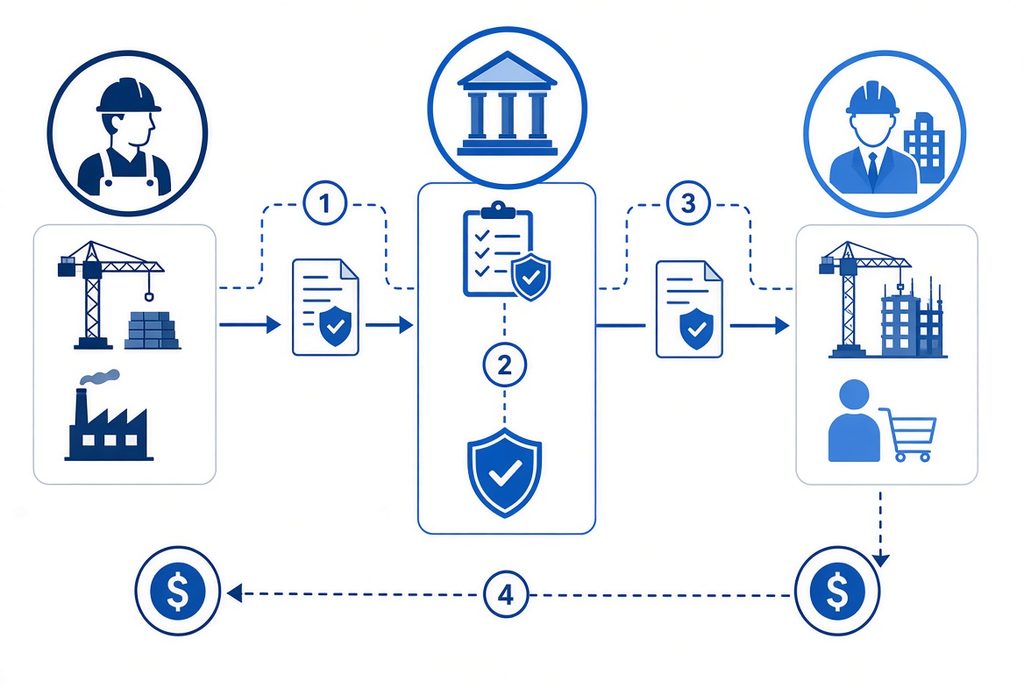
An Advance Payment Guarantee creates a contractual undertaking between the issuing institution and the beneficiary, subject to the terms of the instrument.
The process typically involves three principal parties:
The process normally follows these stages:
- Commercial contract is signed, including advance payment terms.
- Beneficiary states the required APG amount, validity, wording and acceptable banks.
- Applicant submits documentation to the proposed issuing bank or intermediary.
- Bank performs credit, compliance and transaction assessment.
- Guarantee wording is agreed and the instrument is issued (often via SWIFT).
- Beneficiary authenticates the guarantee and releases the advance payment.
- The guarantee may reduce as the advance is recovered through work progress or deliveries, or it remains at full value until expiry/release conditions are met.
Important: An Advance Payment Guarantee does not automatically reduce or terminate when work progresses. Any reduction, release or expiry mechanism must be properly established in the instrument.
What Is the Purpose of an Advance Payment Guarantee?
- Protects the advance payment if the contractor or supplier defaults on related obligations
- Gives buyers greater confidence to release funds early
- Enables contractors and suppliers to access mobilisation capital
- Supports large procurement and cross-border contracts
- Creates a clear, independent claim mechanism
An APG does not remove all commercial risk. Its strength depends on the creditworthiness of the issuing bank, the precision of the wording, and the beneficiary’s ability to present a complying demand.
Where Are Advance Payment Guarantees Used?
Advance Payment Guarantees are used across various industries where suppliers or contractors require funds before completing their contractual obligations.
- Construction and Civil Engineering
Construction companies often require advance payments to purchase materials, mobilise workers, hire machinery and prepare project sites.
A project owner may require an APG before releasing the agreed mobilisation advance. - Infrastructure Development
Large infrastructure projects involving roads, bridges, airports, power facilities and transportation systems may require substantial upfront expenditure.
An APG can help protect the project owner’s advance payment under the relevant construction or supply contract. - Equipment and Machinery Procurement
Industrial equipment, specialised machinery and large-scale production systems may require deposits or advance payments before manufacturing or delivery.
The buyer may request an APG to protect the advance while the equipment is being produced. - International Trade and Importation
In cross-border transactions, an importer may need to pay an overseas supplier before production, shipment or delivery.
An Advance Payment Guarantee can provide a contractual safeguard where the buyer is required to pay before receiving the goods. - Manufacturing and Industrial Supply
Manufacturers may require advance payments to purchase raw materials, reserve production capacity and commence customised manufacturing.
An APG may be requested by the buyer as a condition of releasing the initial payment. - Energy and Natural Resources
Energy, oil and gas, mining and related industrial projects may involve large procurement and construction contracts where advance payments form part of the agreed commercial structure.
The guarantee should be tailored to the specific transaction and the beneficiary’s requirements.
Who Needs The Guarantee?
An Advance Payment Guarantee may be relevant to businesses that receive advance payments under commercial contracts.
Potential applicants include:
• Construction companies and contractors
• Civil engineering companies
• Infrastructure developers
• Equipment manufacturers
• Industrial machinery suppliers
• International exporters
• Manufacturing companies
• Procurement and supply companies
• Energy and power project contractors
• Engineering, procurement and construction (EPC) contractors
• Businesses undertaking large commercial projects
Buyers, employers, government bodies and project owners may also require an APG to protect funds paid before contractual delivery or performance.
What Are the Requirements for Obtaining it ?
The requirements for obtaining an APG depend on the proposed issuing institution, the applicant’s financial position, the transaction structure and the beneficiary’s requirements.
An assessment may consider the following:
Corporate Information
- Certificate of incorporation or company registration
- Memorandum and articles of association, where applicable
- Company ownership structure
- Directors’ information
- Ultimate beneficial ownership information
- Corporate identification and verification documents
Financial Information
- Audited financial statements
- Management accounts
- Recent bank statements
- Information concerning existing financial obligations
- Evidence of financial capacity
- Details of available collateral or security, where required
Commercial Transaction Documents
- Signed commercial agreement
- Purchase order or project contract
- Advance payment schedule
- Description of the goods, services or project
- Total contract value
- Required advance payment amount
- Beneficiary’s details
- Proposed guarantee wording
- Required guarantee validity period
Compliance Documentation
The relevant institution may also require:
- Know Your Customer (KYC) documentation
- Anti-Money Laundering (AML) information
- Source-of-funds information
- Sanctions screening information
- Additional corporate and transaction verification documents
Providing complete and accurate documentation can help reduce delays during the assessment process. It does not guarantee approval or issuance.
How Much Does it Cost?
The cost of an Advance Payment Guarantee varies depending on the issuing institution, applicant, transaction and guarantee structure.
There is no universal APG fee applicable to every transaction.
Factors that may influence the cost include:
1. Guarantee Amount
The larger the guarantee amount, the greater the potential financial exposure of the issuing institution.
2. Guarantee Validity Period
A longer guarantee period may result in higher overall charges.
3. Applicant’s Financial Position
The applicant’s financial strength, credit profile and ability to meet its obligations may influence the institution’s assessment and pricing.
4. Collateral and Security Requirements
Some institutions may require cash collateral, counter-security or other forms of security. Requirements differ between institutions and transactions.
5. Transaction Risk
The nature of the project, beneficiary, applicant, jurisdiction and underlying commercial arrangement may influence pricing.
6. Issuing Institution
Different banks and financial institutions have different underwriting policies, pricing structures and eligibility requirements.
Potential costs may include:
- Guarantee issuance commissions
- Arrangement or structuring fees
- Bank charges
- Legal and documentation expenses
- Correspondent banking charges, where applicable
- Amendment or extension fees
Businesses should obtain a written breakdown of all applicable charges and understand the payment arrangements before proceeding.
How Long Does It Take to Obtain an APG?
The processing time for an Advance Payment Guarantee varies.
Factors influencing the timeline include:
- Completeness of the application
- Complexity of the underlying transaction
- Applicant’s financial position
- Internal institutional approval procedures
- Compliance and due diligence checks
- Beneficiary approval of the guarantee wording
- Any collateral or security arrangements
Straightforward transactions with complete documentation may be assessed more efficiently than complex transactions requiring additional approvals.
Applicants should avoid relying on an assumed issuance date until the proposed issuing institution has confirmed its requirements and expected timeline.
Advance Payment Guarantee vs. Performance Guarantee
Although both instruments are commonly used in commercial contracts, an Advance Payment Guarantee and a Performance Guarantee serve different purposes.
| Feature | Advance Payment Guarantee | Performance Guarantee |
| Main purpose | Protects an advance payment | Supports specified contractual performance obligations |
| Main risk addressed | Failure to meet obligations relating to the advance | Failure to perform specified contractual obligations |
| Typical beneficiary | Buyer or project owner | Buyer, employer or project owner |
| Typical applicant | Supplier or contractor receiving an advance | Contractor or supplier undertaking performance |
| Amount | Usually linked to the advance payment | Determined by the contract |
| Reduction | May reduce as the advance is recovered | Depends on the guarantee terms |
A commercial contract may require both instruments.
For example, a construction project may require an APG to protect a mobilisation advance and a separate Performance Guarantee to address specified performance obligations.
The two instruments should be reviewed separately to ensure that their purposes, claim conditions and validity periods are clearly defined.
Advance Payment vs. Bank Guarantee
An Advance Payment Guarantee is a particular type of guarantee arrangement. A bank guarantee is a broader category of financial undertaking.
A bank may issue an APG specifically to protect an advance payment under a commercial contract.
Other types of guarantees may include:
- Performance Guarantees
- Bid Bonds or Tender Guarantees
- Financial Guarantees
- Payment Guarantees
- Warranty Guarantees
- Retention Money Guarantees
- Customs Guarantees
The appropriate instrument depends on the commercial obligation being secured.
It is important not to confuse an APG with a general bank guarantee because each instrument has its own purpose, wording and claim requirements.
What Should You Check Before Accepting The Guarantee?
The wording and issuing arrangements are critical to the effectiveness of an APG.
Before accepting a guarantee, the beneficiary should consider:
Issuing Institution
Confirm the identity of the guarantor, its authority to issue the instrument, its financial standing and whether the beneficiary accepts it.
Guarantee Amount
Check that the amount and currency correspond with the agreed advance payment protection.
Expiry Date
Ensure that the guarantee remains valid for the period required under the commercial contract.
Claim Conditions
Understand the documents, statements and other requirements that must be presented to make a valid demand.
Applicable Rules and Governing Law
Check the governing law, jurisdiction and any incorporated rules.
For example, the International Chamber of Commerce’s Uniform Rules for Demand Guarantees (URDG 758) may apply when expressly incorporated into the guarantee.
Reduction Mechanism
Confirm whether the guarantee reduces as the advance is recovered, what evidence is required and how reductions become effective.
Authentication and Delivery
Verify the guarantee through the agreed banking or institutional channels. Do not rely solely on emailed copies or documents supplied by an unverified intermediary.
Common Risks and Mistakes
Despite their usefulness, APGs can create problems when the instrument is poorly structured or the parties misunderstand its conditions.
Common mistakes include:
- Incorrect guarantee wording: The instrument does not satisfy the beneficiary’s contractual requirements.
- Unacceptable issuing institution: The beneficiary does not recognise or accept the proposed guarantor.
- Insufficient validity: The guarantee expires before the relevant protection period ends.
- Unclear claim conditions: The beneficiary does not understand what must be presented to make a complying demand.
- Incorrect guarantee amount: The guarantee does not match the agreed advance payment.
- Unclear reduction provisions: The parties disagree about when or how the guaranteed amount should reduce.
- Inadequate verification: The beneficiary fails to authenticate the instrument through reliable channels.
- Unclear fees: The applicant does not fully understand the costs and payment obligations.
- Incomplete due diligence: The parties fail to verify the applicant, beneficiary, transaction or issuing institution.
A careful review before issuance can help prevent avoidable disputes and documentation problems.
How Can TRG Venture Capital International Investment G.P. Limited Help?
Businesses exploring an Advance Payment Guarantee often need to understand the transaction requirements, documentation, institutional criteria and commercial considerations before deciding how to proceed.
TRG Venture Capital International Investment G.P. Limited, based in St Helier, Jersey, is a point of contact for businesses wishing to discuss their guarantee-related and financial transaction requirements.
Businesses considering an APG can contact TRG to discuss the nature of their proposed transaction and the requirements they need to address.
When making an initial enquiry, it is useful to have the following information available:
- Company name and registration details
- Description of the underlying commercial transaction
- Total contract value
- Proposed advance payment amount
- Beneficiary’s name and country
- Applicant’s country of registration
- Required guarantee currency
- Required guarantee validity period
- Copy of the relevant contract or purchase order
- Any guarantee wording or requirements supplied by the beneficiary
The suitability, availability and terms of any proposed arrangement depend on the transaction, the relevant institution’s requirements, applicable compliance procedures and the necessary approvals.
No guarantee issuance, approval, pricing or processing timeframe should be assumed until confirmed by the relevant institution.
Frequently Asked Questions About Advance Payment Guarantees
- What is an Advance Payment Guarantee?
An Advance Payment Guarantee is a financial undertaking, generally issued by a bank or financial institution, that protects a beneficiary in relation to an advance payment made under a commercial contract. It allows the beneficiary to make a claim when the guarantee’s specified conditions are satisfied. - What does APG stand for in finance?
APG stands for Advance Payment Guarantee. It is used in commercial transactions where a buyer or project owner makes an advance payment to a supplier or contractor. - Who issues an Advance Payment Guarantee?
An APG is generally issued by a bank or another financial institution acceptable to the beneficiary. The issuing institution assesses the applicant and transaction before deciding whether to issue the guarantee. - Can an Advance Payment Guarantee be used for international trade?
Yes. APGs are used in international trade when an importer makes an advance payment to an overseas supplier before production, shipment or delivery. - How can my company discuss an Advance Payment Guarantee with TRG?
Companies interested in discussing APG requirements can contact TRG Venture Capital International Investment G.P. Limited at its St Helier, Jersey business address. It is helpful to provide the underlying contract, advance payment amount, beneficiary details and required validity period when making an enquiry.
Contact TRG Venture Capital International Investment G.P. Limited for Advance Payment Guarantee Requirements
Is your company looking for an Advance Payment Guarantee (APG) to support a construction contract, international trade transaction, equipment procurement or infrastructure project?
TRG Venture Capital International Investment G.P. Limited welcomes enquiries from businesses seeking to discuss Advance Payment Guarantees, bank guarantees and related financial instruments.
Our team can discuss your proposed transaction, documentation requirements and potential financial arrangements, subject to the relevant institutional assessment, compliance procedures and approvals.
Contact TRG Venture Capital International Investment G.P. Limited
• Website: https://trgventure.capital/
• Email: info@trgventure.capital
• Address: 26 New Street, St Helier, Jersey, JE2 3RA, United Kingdom
Discuss your Advance Payment Guarantee requirements with TRG today.
When contacting us, please include your company details, contract value, required advance payment amount, beneficiary information and proposed guarantee validity period to help us understand your requirements.
All proposed transactions are subject to eligibility, due diligence, institutional approval and applicable legal and regulatory requirements.