
Standby Letters of Credit: Requirements, Costs & Issuance Guide
Standby letters of credit requirements costs and issuance procedures form the foundation of secure international trade and project finance. Businesses that need contingent payment support turn to these instruments when counterparties demand assurance without full cash collateral. TRG Venture Capital International Investment G.P. Limited guides clients through every stage so that firms secure the right structure, control expenses, and complete issuance on schedule.
#SBLC #TradeFinance #BankGuarantee
A standby letter of credit, often called an SBLC or SLOC, is an irrevocable undertaking issued by a bank. The bank promises to pay the beneficiary if the applicant fails to meet a defined obligation. Unlike a commercial letter of credit that drives primary payment against shipping documents, the SBLC stands ready only in case of default or non-performance. Banks issue these instruments under ISP98 or UCP 600 rules. The choice of rules affects examination standards, presentation requirements, and dispute handling.
TRG Venture Capital International Investment G.P. Limited works with applicants who need performance standbys, financial standbys, bid standbys, and advance-payment standbys. Each type serves a distinct commercial purpose. Performance standbys support contract completion. Financial standbys secure payment obligations. Bid standbys back tender offers. Advance-payment standbys protect funds paid before delivery. Understanding the correct type prevents later amendments and extra fees.
What Drives Demand for Standby Letters of Credit
Companies request SBLCs when they enter large contracts, expand into new markets, or face counterparties that require bank support. Construction firms use them for performance security. Exporters and importers use them to replace cash deposits. Project sponsors use them to satisfy lenders. In each case the instrument reduces the beneficiary’s risk while allowing the applicant to preserve working capital.
The instrument creates a contingent liability for the issuing bank. Regulators therefore treat SBLCs as credit exposures. Banks apply capital charges and require the applicant to demonstrate capacity to reimburse any drawing. TRG Venture Capital International Investment G.P. Limited prepares clients for this underwriting review so that applications move forward without unnecessary delays.
Core Requirements for Issuance
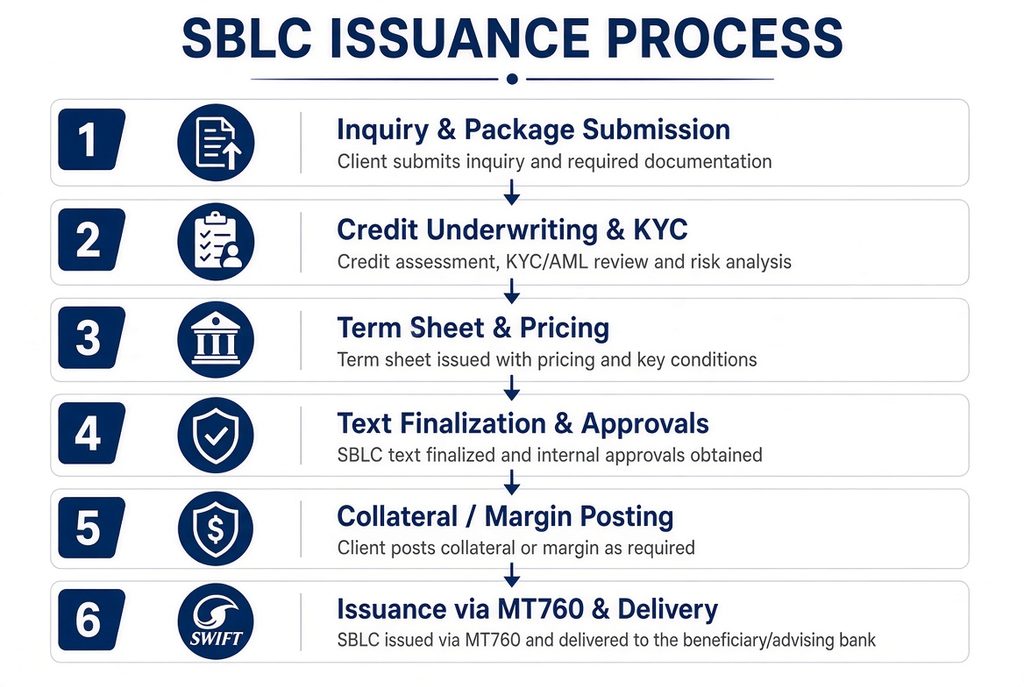
Banks evaluate several factors before they issue an SBLC. First they examine the applicant’s credit profile. Audited financial statements, cash-flow projections, and existing banking relationships form the base package. Second they review the underlying contract or tender documents. The bank needs to understand the obligation that the SBLC supports. Third they assess collateral or margin. Full cash collateral reduces pricing. Partial collateral or a credit facility raises the fee but frees liquidity.
Applicants must also complete KYC and sanctions screening. Beneficial ownership information, corporate resolutions, and board approvals form part of the package. The standby text itself requires careful drafting. Parties must state the maximum amount, expiry date, presentation place, required demand documents, and governing rules. Ambiguous wording invites disputes and can delay issuance.
TRG Venture Capital International Investment G.P. Limited assists clients in assembling complete packages. We align the standby text with ISP98 or UCP 600, confirm that demand conditions remain objective, and coordinate with issuing banks that meet the beneficiary’s rating and jurisdiction requirements.
Typical Costs and Pricing Drivers
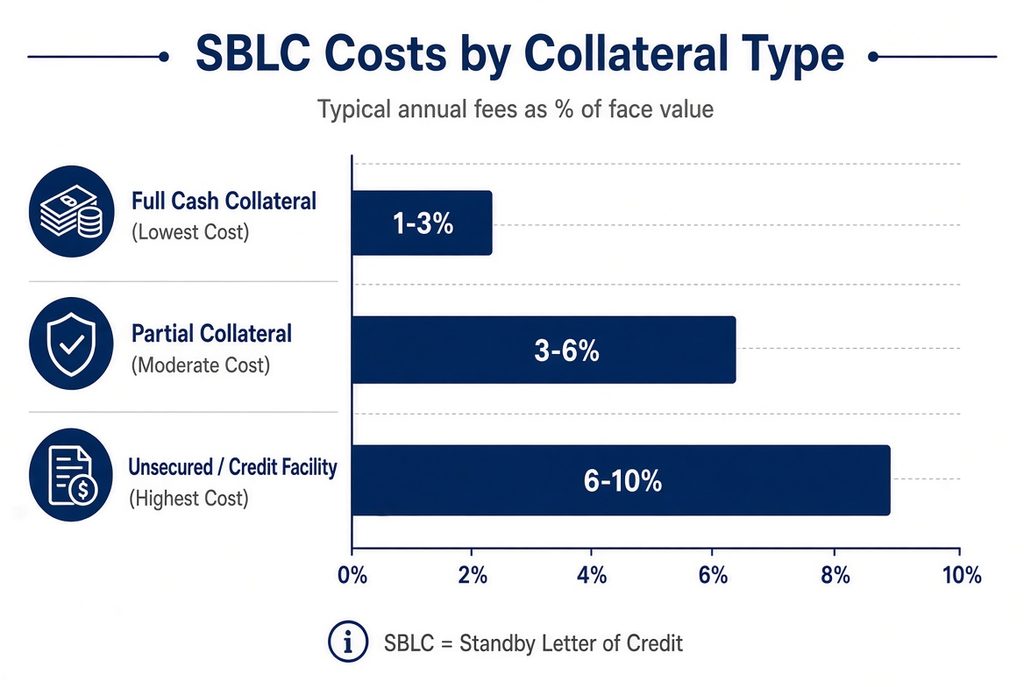
Costs for standby letters of credit usually range from 1 percent to 10 percent of the face amount per year, according to market practice reported by Investopedia. The exact rate depends on several variables.
Credit quality of the applicant carries the greatest weight. Strong balance sheets and established banking relationships produce lower fees. Collateral coverage also matters. Cash-backed SBLCs price at the low end of the range. Unsecured or partially secured instruments price higher. Tenor affects cost because banks charge for the full period of risk. Longer instruments or evergreen clauses increase the annual fee. Bank internal processing costs, capital charges under Basel rules, and confirmation fees when a second bank adds its undertaking also enter the calculation.
Additional charges appear for amendments, cancellations, and document examination if a drawing occurs. Most SBLCs never face a drawing, so examination fees remain rare. Still, applicants should budget for SWIFT fees, courier costs, and legal review of the final text.
TRG Venture Capital International Investment G.P. Limited helps clients compare term sheets from multiple banks. We identify opportunities to reduce margin requirements through structured collateral packages and negotiate fee schedules that match the commercial timeline of the underlying project.
Step-by-Step Issuance Procedures
Issuance follows a clear sequence. The process begins with an inquiry. The applicant supplies a summary of the obligation, proposed amount, tenor, and beneficiary details. Preliminary screening follows. Banks check sanctions lists and basic credit indicators.
Next the applicant submits a full package: financial statements, corporate documents, underlying contract, draft standby wording, and proposed security arrangements. The bank underwrites the risk, sets the fee, and issues a term sheet or commitment letter. Once the parties agree on terms, the bank prepares the final instrument text.
The applicant reviews and accepts the text. Corporate resolutions authorizing the transaction are executed. Margin or collateral is posted. The bank then issues the SBLC, typically via SWIFT MT760 message. The advising bank receives the message, authenticates it, and delivers the instrument to the beneficiary.
If confirmation is required, a second bank adds its undertaking. Confirmation protects the beneficiary against issuing-bank or country risk and adds a further fee layer.
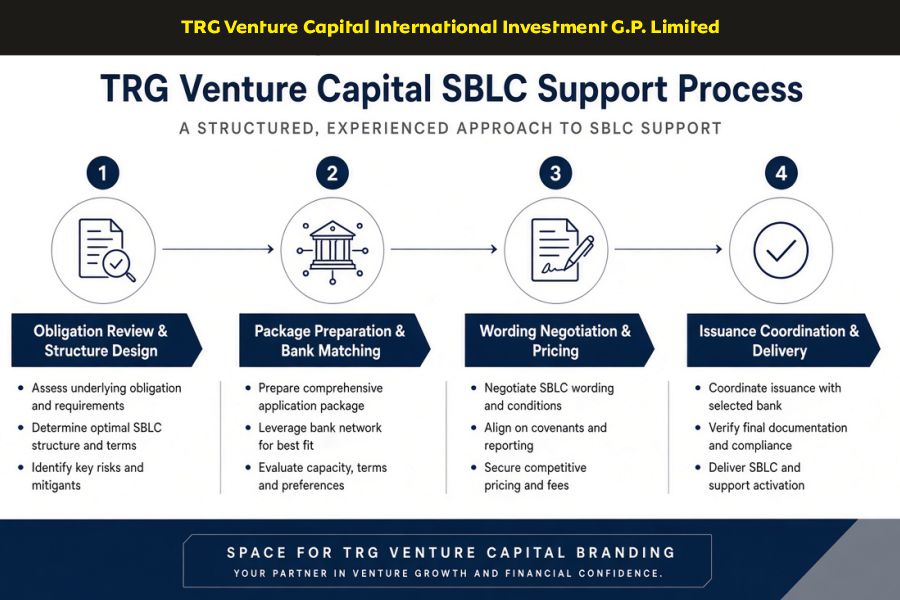
Throughout the process TRG Venture Capital International Investment G.P. Limited coordinates communication among applicant, issuing bank, advising bank, and beneficiary. We track timelines, resolve wording issues, and ensure that conditions precedent are satisfied before the instrument leaves the issuer’s control.
Real-World Example
A buyer required a performance SBLC equal to 10 percent of the contract value for a 24-month period after an engineering firm won a contract to supply specialized equipment to an overseas energy project. Then the firm approached its relationship bank. After reviewing three years of audited accounts and the signed contract, the bank offers an SBLC at 2.5 percent per annum against 40 percent cash margin and an assignment of contract proceeds. The firm posts the margin, accepts ISP98 wording, and receives the MT760 within 12 business days. The project proceeds without cash being locked for the full amount.
This shows how essential and reliable sblcs become in international trade.
TRG Project Finance Support:
A renewable-energy developer needed a $15 million advance-payment SBLC to unlock milestone payments from a government buyer. Traditional banks required 100 percent cash collateral, which would have strained the developer’s liquidity. TRG Venture Capital International Investment G.P. Limited structured a hybrid solution. The developer provided 30 percent cash margin, a security interest in project assets, and a limited guarantee from the parent company. We introduced the package to two international banks experienced in renewable-energy risk. One bank issued the SBLC under ISP98 at 3.75 percent per annum. The instrument was confirmed by a bank in the buyer’s jurisdiction. The developer received the advance payment on schedule, completed construction, and released the SBLC upon final acceptance. The structure preserved working capital and met the buyer’s security requirements without delaying the project timeline.
standby letters of credit requirements: Common Pitfalls and How to Avoid Them
Applicants often underestimate the time required for underwriting and wording negotiation. Starting the process late creates pressure and weakens bargaining position. Incomplete financial packages slow credit approval. Overly complex demand conditions invite later disputes. Choosing the wrong governing rules can create mismatches with local practice. TRG Venture Capital International Investment G.P. Limited addresses these issues by preparing clients early, standardizing high-quality packages, and selecting banks whose internal policies align with the transaction.
How TRG Venture Capital International Investment G.P. Limited Adds Value
TRG Venture Capital International Investment G.P. Limited specializes in structured trade finance and contingent instruments. We maintain relationships with banks that issue SBLCs for performance, financial, and project obligations. Our team reviews underlying contracts, drafts or refines standby text, prepares credit packages, and manages the full issuance process. Clients benefit from competitive pricing, faster timelines, and instruments that satisfy sophisticated beneficiaries. We also advise on related structures such as bank guarantees, bid bonds, and monetization options when liquidity needs arise after issuance.
We Provide Loan, Sblc/Bank guarantee funding For Startups. Small Businesses (SMEs). Medium and Large Business. Public and Private Companies. Service Companies. Construction Companies. Agricultural Companies. Mining Companies. Real Estate. Energy Companies. Manufacturing Companies. Companies Looking to Go Public. Companies Across All Industries.
Do well to read our article on Project Finance Loans 2026 | Fund Projects Without Risk
standby letters of credit requirements: Frequently Asked Questions
What documents does a bank require to issue a standby letter of credit?
Banks typically request audited financial statements, corporate resolutions, KYC documentation, the underlying contract or tender package, and proposed standby wording. Additional security documents may be required depending on collateral arrangements.
How long does SBLC issuance usually take?
Straightforward cases with established banking relationships can complete in 7 to 15 business days after submission of a complete package. Complex credit structures or new banking relationships may require several weeks.
Can an SBLC be issued without cash collateral?
Yes. Banks may accept alternative collateral, guarantees, or unsecured credit facilities when the applicant demonstrates strong credit quality. Pricing rises as collateral coverage falls.
What is the difference between ISP98 and UCP 600 for standby letters of credit?
ISP98 was written specifically for standbys and focuses on demand presentation. UCP 600 was written for documentary credits and applies document-examination standards that can prove more cumbersome for pure contingent instruments. Most pure standbys perform better under ISP98.
Does the beneficiary need to present documents to draw under an SBLC?
Yes. The beneficiary must present a demand that complies with the terms of the standby. Typical requirements include a statement of default and any other documents listed in the instrument. Presentation must occur before expiry at the place specified in the text.
standby letters of credit requirements: Summary
Standby letters of credit remain essential tools for managing counterparty risk in trade and project finance. Successful use depends on clear understanding of requirements, realistic cost expectations, and disciplined issuance procedures. Applicants who prepare complete packages, choose appropriate governing rules, and work with experienced advisors secure instruments that protect relationships and preserve capital. TRG Venture Capital International Investment G.P. Limited supports clients at every stage of this process so that businesses obtain the security they need without unnecessary cost or delay.
Contact TRG Venture Capital International Investment G.P. Limited for Standby Letter of Credit Requirements
Is your company looking for a standby letter of credit to support a construction contract, international trade transaction, equipment procurement or infrastructure project?
TRG Venture Capital International Investment G.P. Limited welcomes enquiries from businesses seeking to discuss standby letters of credit and related financial instruments.
Our team can discuss your proposed transaction, documentation requirements and potential arrangements, subject to the relevant institutional assessment, compliance procedures and approvals.
Contact TRG Venture Capital International Investment G.P. Limited
- Website: https://trgventure.capital/
- Email: info@trgventure.capital
- Address: 26 New Street, St Helier, Jersey, JE2 3RA, United Kingdom
Get a Standby Letter of Credit From TRG today.
When contacting us, please include your company details, contract value, required advance payment amount, beneficiary information and proposed guarantee validity period to help us understand your requirements.
All proposed transactions are subject to eligibility, due diligence, institutional approval and applicable legal and regulatory requirements.