
SBLC vs Letter of Credit
Businesses that move goods or fund projects across borders often face the choice between an SBLC and a letter of credit. TRG Venture Capital International Investment G.P. Limited helps clients select and structure the right instrument so capital stays protected and transactions close on schedule. This guide covers SBLC vs Letter of Credit in detail, shows when each fit, and explains how the right choice supports growth. You will find definitions, a side-by-side comparison, a real-world example, a case study, and answers to common questions.
A letter of credit serves as the primary payment method in many trade deals. An SBLC acts as a backup that pays only when the applicant fails to perform. Understanding this core split prevents costly errors. We will examine purpose, triggers, rules, costs, and practical application so you can decide with confidence.
What a Letter of Credit Does
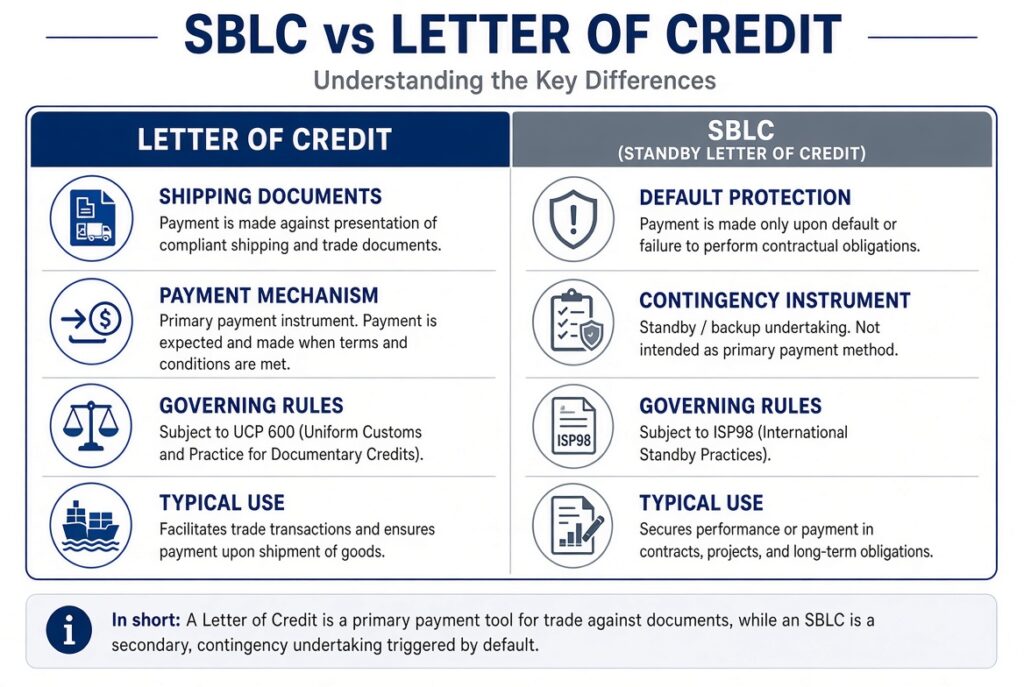
A letter of credit is a bank undertaking that pays the beneficiary once compliant documents arrive. The issuing bank examines the papers against the stated terms. If the documents match, payment follows. Buyers and sellers use this tool when they want certainty that shipment and payment occur together. Common documents include the commercial invoice, bill of lading, and inspection certificate. The governing framework is usually UCP 600.
Banks issue the instrument after reviewing the applicant’s credit. The beneficiary ships, presents documents, and receives funds. This process reduces the risk that the buyer will refuse payment after receiving goods. International traders rely on the instrument because distance and differing legal systems create uncertainty. For further background on the instrument itself, see the detailed overview of a letter of credit published by Investopedia.
What an SBLC Does
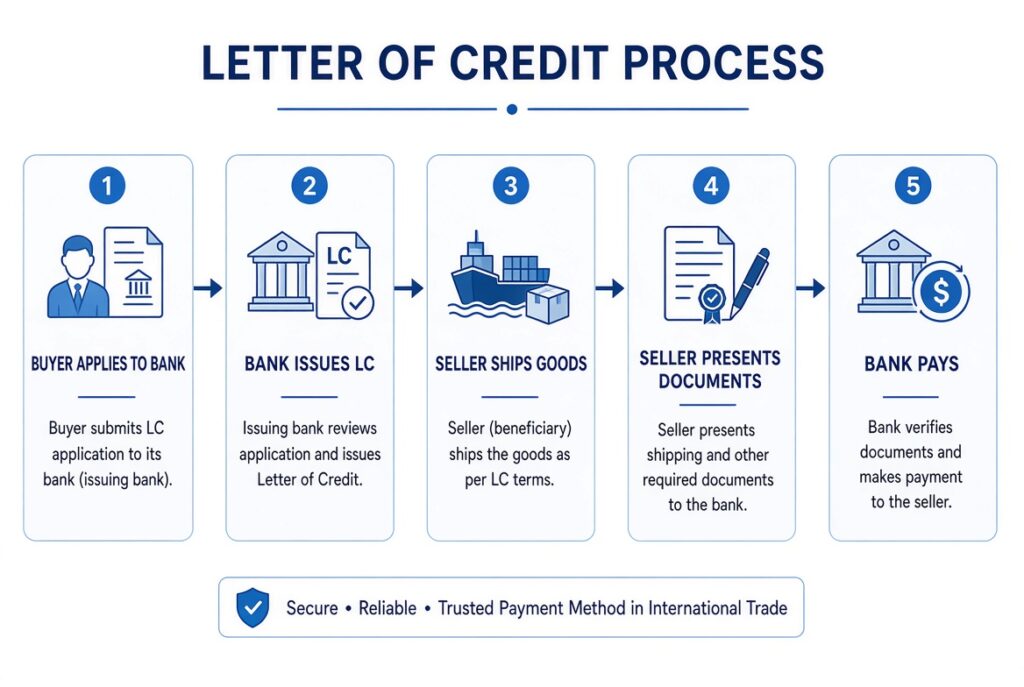
A standby letter of credit, or SBLC, functions as a contingent guarantee. The bank pays the beneficiary only after the applicant defaults or fails to meet a contractual duty. Until that moment the instrument stays unused. Parties treat it as security rather than a routine payment channel. Typical uses include performance support on construction contracts, lease payment backstops, and long-term supply arrangements.
Issuance often follows ISP98, though UCP 600 remains available. The demand usually consists of a simple statement of default plus any documents the SBLC requires. Banks examine the demand for compliance with the SBLC terms and then pay. Because the instrument is independent of the underlying contract, the bank does not investigate the actual dispute.
SBLC vs Letter of Credit: How they Protect Parties
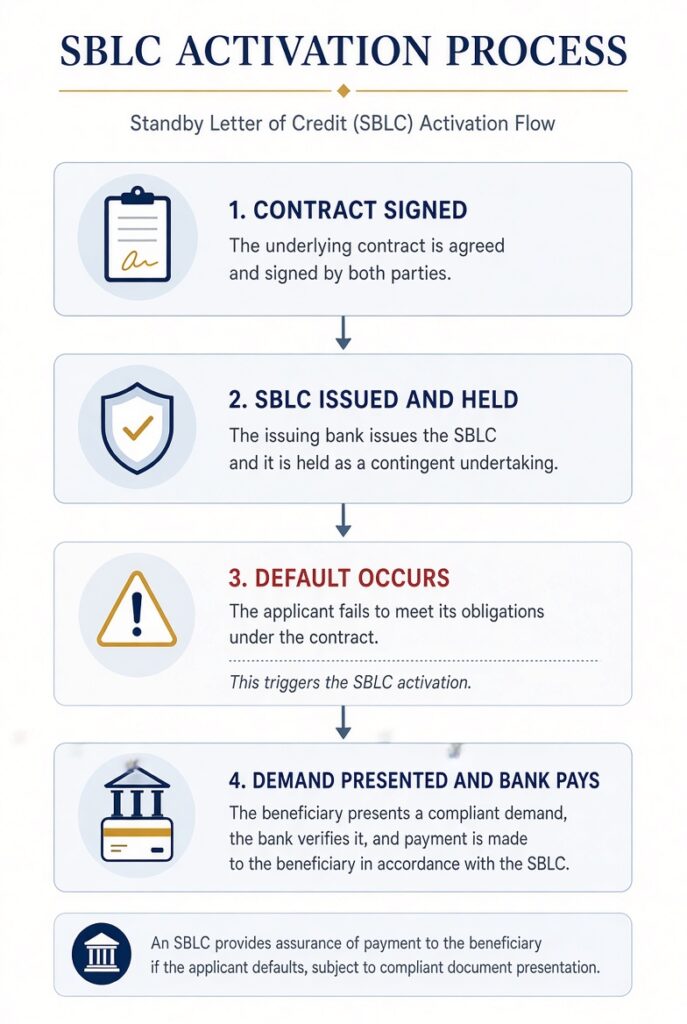
A letter of credit protects the seller by shifting payment risk to the issuing bank. Once compliant documents appear, the bank must pay even if the buyer later becomes insolvent. The buyer gains assurance that funds leave only after evidence of shipment arrives. An SBLC protects the beneficiary by providing a ready source of funds if the counterparty defaults. The applicant keeps cash free for operations because the instrument does not require pre-funding of the full amount in every case.
Both instruments rest on the principle of independence. The bank deals only in documents or demands, not in the goods or the merits of any dispute. This separation creates reliability across borders.
SBLC vs Letter of Credit: Cost and Capital Considerations
Banks price each instrument according to risk, tenor, and collateral. A short tenor letter of credit for a well-known buyer can cost less than a multi-year SBLC. Confirmation by a second bank adds cost but reduces country or bank risk for the beneficiary. Collateral requirements vary. Strong applicants may obtain either instrument against a modest cash margin or other security. Weaker credits face higher margins or full cash collateral.
TRG Venture Capital International Investment G.P. Limited structures these facilities so clients avoid locking excess capital. Our team reviews the underlying contract, assesses the counterparty, and matches the instrument to the risk profile. Clients therefore keep working capital available for operations while still satisfying counterparties.
Do well to read our article on Business Loan Lenders That Drive Expansion
Real-World Example: Machinery Import
When a European distributor agrees to purchase industrial equipment valued at several million euros from an Asian manufacturer’ The parties select a letter of credit as the payment method. The buyer’s bank issues the letter of credit under UCP 600. The manufacturer ships the machines, presents the bill of lading, invoice, and inspection certificate, and receives payment once the bank confirms compliance. The transaction completes without any claim on a standby instrument because both sides perform as agreed. The letter of credit simply facilitates the exchange of documents for funds.
If the same parties had chosen an SBLC, the instrument would have sat unused. Payment would have occurred through ordinary banking channels, and the SBLC would have served only as backup security. The letter of credit proved the efficient choice because the deal centered on a single shipment of goods.
Case Study: Performance Support for a Solar Project
A Texas solar developer needed to provide security to a utility under a power purchase agreement. The utility required an SBLC covering performance milestones and payment obligations. The developer’s bank initially requested 100 percent cash collateral. That demand would have drained liquidity and delayed construction.
Working with advisors, the developer arranged an SBLC structure that combined a modest cash reserve with a pledge over a portion of future revenues under the power-purchase agreement. The issuing bank accepted the package. The SBLC activated within two months. Construction proceeded on schedule. The developer preserved most of its cash for equipment purchases and site work. When milestones were met, the SBLC remained undrawn and eventually expired. The case illustrates how an SBLC can unlock a project without immobilizing the full guaranteed amount.
SBLC vs Letter of Credit: When to Choose Each Instrument
Select a letter of credit when the transaction involves physical goods, when documents can clearly evidence performance, and when the parties want payment to flow automatically upon shipment. The instrument fits new trading relationships and high-value single shipments.
Select an SBLC when the obligation is performance-based, spans multiple years, or covers financial commitments such as leases or project completion. The instrument fits construction contracts, long-term supply agreements, and situations where the beneficiary needs security against default rather than routine payment processing.
Some deals combine both. A commercial letter of credit may handle the shipment while an SBLC backs related performance warranties. Clear drafting avoids overlap and double costs.
Rules That Govern the Instruments
UCP 600 sets detailed standards for document examination, time limits, and transport documents. It works well when shipping papers form the core of the presentation. ISP98 focuses on demand language, notice periods, and automatic extension clauses. It better matches the contingent nature of most SBLCs. Parties should state the chosen rules explicitly in the instrument. Banks and courts then apply a consistent framework.
Practical Steps to Obtain Either Instrument
Begin with a clear underlying contract that states the required security. Approach a bank or specialized provider such as TRG Venture Capital International Investment G.P. Limited with full financials, the draft contract, and details of the counterparty. The issuer reviews credit, sets collateral terms, and drafts the instrument. Once the beneficiary accepts the wording, the bank issues via SWIFT. The process normally completes in days to a few weeks depending on complexity and documentation quality.
Frequently Asked Questions
What is the main difference between an SBLC and a letter of credit?
A letter of credit serves as the primary payment method and pays against compliant trade documents. An SBLC serves as a contingent guarantee and pays only upon documented default.
Can an SBLC replace a commercial letter of credit?
No. The instruments serve different functions. Using an SBLC for routine shipment payment would leave the seller without a clear document-driven payment path.
Which rules apply to an SBLC?
ISP98 is preferred for most standbys. UCP 600 remains available and is sometimes chosen when the demand requires trade-style documents.
How much does each instrument cost?
Costs vary by bank, risk, and tenor. Letters of credit often price lower for short transactions. SBLCs usually carry an annual fee reflecting longer contingent exposure.
Does TRG Venture Capital International Investment G.P. Limited issue both instruments?
Yes. We arrange letters of credit and SBLCs as part of broader trade-finance and project-support solutions. Clients receive structured terms that align with cash-flow needs.
Is an SBLC the same as a bank guarantee?
They perform similar economic functions, yet an SBLC follows letter-of-credit rules and documentary independence while many bank guarantees follow different national or URDG frameworks.
SBLC vs Letter of Credit comes down to primary payment versus contingent security. Letters of credit move funds when documents confirm shipment. SBLCs pay only when performance fails. Purpose, trigger, rules, cost, and industry use all flow from that split.
Businesses that match the instrument to the risk protect capital, satisfy counterparties, and keep deals on track. TRG Venture Capital International Investment G.P. Limited structures both instruments so clients obtain the protection they need without excess capital lock-up. The right choice supports growth in trade and project finance.
#SBLCvsLC #TradeFinance #StandbyLetterOfCredit #LetterOfCredit #ProjectFinance #TRGVentureCapital
Contact TRG Venture Capital International Investment G.P. Limited today. Our team reviews your contract, designs the optimal letter of credit or SBLC, and delivers the facility with clear terms and rapid execution. Reach out now to protect your transaction and free working capital for growth. Do not leave payment or performance risk unaddressed. Secure the instrument that fits and move forward with confidence.
Contact us @ trgventure.capital
Email: info@trgventure.capital